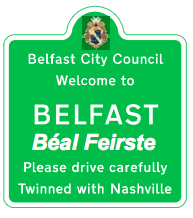
Yesterday, the Minister for Regional Development for Northern Ireland, Conor Murphy MP MLA, launched a consultation process into the bilingual provision of particular classes of traffic signs.
Much has been said about this by politicians: much of it is negative.
This is a Sinn Fein [sic] hobby horse and not a sensible proposal given the budgetary constraints faced by Departments. – Michelle McIlveen MLA
The latest census shows that of 1.6 million people in NI only 167,490 [10% then (why leave it out?) – Ed.] had some knowledge of Irish and only 35,000 (2%) of the population had any knowledge of Ulster Scots. – Tom Elliott MLA
This plan will mean that their will be clear tribal demarcations in area because there can never be a sign featuring the three languages together. This is akin to people putting flags up in certain areas to mark out territory. This will be like an institutionalised mark of tribalism. – Anna Lo MLA
Unionists will not be fooled by Murphy’s nod and wink towards the Ulster-Scots movement. These proposals have one aim and one only – the gradual erosion of Northern Ireland’s Britishness [. -Ed.] – Jim Allister
MEP
Whilst I agree that it could ghettoize Northern Ireland, there is a wider more positive benefit to using Irish on signs in Northern Ireland, as I have said in an earlier article in Gyronny Herald,
We have a rich cultural heritage in our placenames in Northern Ireland, but sadly there are far too few times when we see the original language (Gaeilge) in use on public signs.
I said then, and still do say that we are missing out on our cultural heritage.
The Ulster Scots question
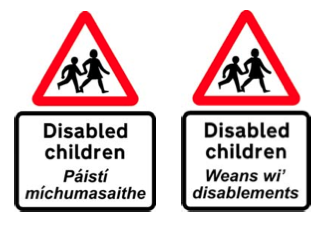
Now, I understand that some in Northern Ireland (about 2% if you use the figures in the Consultation document) use another language dialect and some people want to see it in use on signs. Personally, I don’t see the benefit of ‘Ulster-Scots’ on roadsigns. Is it even a language?
As a friend said to me earlier today,
Where is the literature? Where is the online lexicon?
I can find neither. There is literature in Scots – but Ulster Scots?
Even Mr Allister of the Traditional Unionist Voice appears, in his press statement, to only recognise Ulster-Scots as a movement – not a community. Maybe it doesn’t really exist. Who knows it may really only be a made up language on the misapprehension of some Ulster Protestants that since the ‘Catholics have Irish we must have our own language’, forgetting that Irish is/was their heritage. (see later)
Gaeilge – language of our forefathers
If Northern Ireland politicians cannot see that using the language – often of their forefathers, if they but knew it – is not about tribal rights, but about heritage, and a common heritage at that, we could get much further along than we do.
Earlier in the month I read that
One common assumption is the assertion that the Irish language is not part of the ‘heritage of the Irish Protestant community’ and that this marks a historical linguistic divide between the ‘two great communities inhabiting the island’.*
[This assertion] depends on the belief that the ‘planters’ and natives never mixed socially or intermarried; and it does not take the presence of a UDA leader named Murphy and an IRA officer named Bell at the Lenadoon confrontation in 1972, or any other set of counterpoints (Cosgrave/McCuskeker, Adams/Magennis, Fry/McGimpsey, say)§
Many, many of us here in what is now Northern Ireland have forebears who used the Irish language. It is true that many of us now do not. Personally, I have had an interest in the language from about the age of eleven, albeit that I have not had enough opportunity to learn the language: this being denied me in my school.
Look around you? Nearly every placename in Northern Ireland comes from Irish. Why do we not value our heritage – it is a common heritage.
Some examples:
Ballymacarret – Baile Mhic Gearóid
Braniel – An Braineal
Knock – An Cnoc
Carniny – Carn Fhainche
Ballycloghan – Baile Clocháin
Belfast – Béal Feirste
Ahoghill – Achadh Eochaille
Shankill – An tSeanchill
Until many, mostly political unionists and cultural Protestants, stop seeing any language use other that of English as an attack on being British, we will have a hard job in using any such language. However, as I have said before, and has been said by many, if these self same people would look back in their heritage they would find that they are likely to have ancestors who used Irish, and if not Irish, then Scots Gaelic. Scots Gaelic of course like Welsh is in use on roadsigns in other parts of their so-beloved United Kingdom. In other words, they need to relearn the history of this island and come to the understanding that diversity is often a way of unifying a whole country.
Although we may not all use the same language, we still recognize everyone as being part of our country. If I were in some parts of England, I would have no problem in their being signs in other minority languages – indeed in and around Chinatown in London, there are signs in English and Chinese languages.
Bilingual signs already in existence
Oh, and by the way, Northern Ireland Railways have some bilingual signs in stations, and Belfast Metro have on bus stops particularly towards the Royal Hospitals.
Footnotes
* P Ó Snodaigh, Hidden Ulster: Protestants and the Irish Language, Lagan Press, Belfast, 1995, p. 18.
§ P Ó Snodaigh, op. cit., p. 19
Related Article
- Is Ulster Scots a form of text messages or a langugage ? (politics.ie)


My own opposition to doing this is based on one thing alone: we cannot afford to replace serviceable signs. If a sign is worn out, no longer accurate, or the road layout changes, then there is no harm in making the replacement bilingual – but replacing perfectly good monolingual signs for no other reason is a waste of money we cannot afford.
LikeLike
[…] linguistic diversity should be a positive benefit to all (gyronny.wordpress.com) […]
LikeLike