

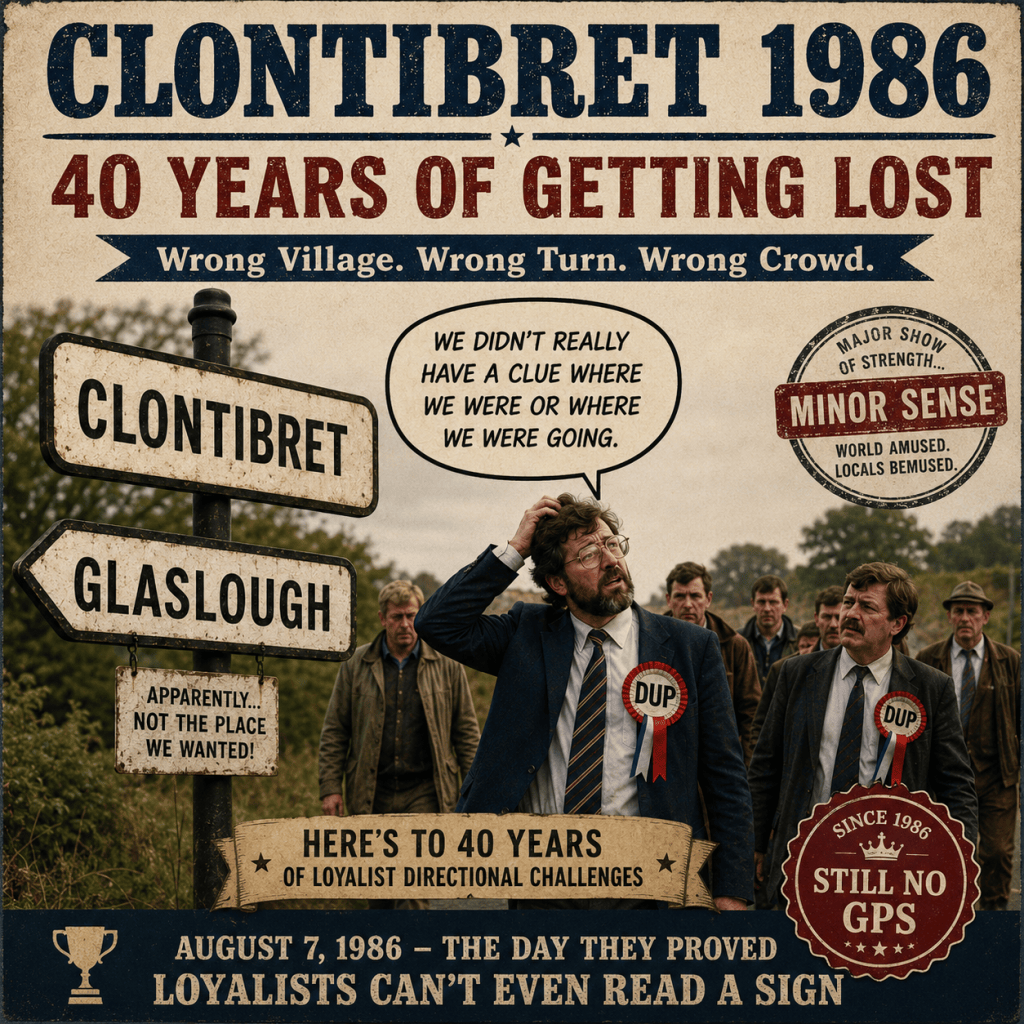
“We didn’t really have a clue where we were or where we were going.” Forty years.
The 1986 loyalist incursion into Clontibret was intended as a dramatic demonstration of defiance. It was also, in parts, spectacularly inept.
Reading Ivan Little’s piece in today’s Belfast Telegraph about the loyalist incursion into Clontibret in August 1986, one particular detail deserves to be preserved for posterity.
Some of them got lost.
This was not, remember, a Sunday afternoon motoring excursion in which somebody missed the turning for the garden centre. This was supposed to be a carefully organised political demonstration.
On 7 August 1986, Peter Robinson, then deputy leader of the DUP, led a large group of loyalists across the border into Clontibret, County Monaghan.
The purpose was political theatre: a dramatic protest against the Anglo-Irish Agreement, signed the previous November by Margaret Thatcher and Garret FitzGerald. Unionism was furious that the agreement gave the Irish government a consultative role in the affairs of Northern Ireland.
So far, so serious.
The execution was rather less impressive.
We didn’t really have a clue
As Little recounts, the loyalists had met in Tandragee before setting out. But former DUP politician Jim Wells and a number of others somehow ended up in Glaslough rather than Clontibret.
Wells’s recollection is magnificent:
“We didn’t really have a clue where we were or where we were going.”
There are occasions when a satirist has to exaggerate.
This is not one of them.
Imagine the scene. You have assembled to protest against Dublin having any influence whatsoever in Northern Ireland. You are preparing to cross the border into the Republic of Ireland in an act designed to demonstrate loyalist determination.
And then you cannot find the village.
There is something exquisitely absurd about making a grand political statement concerning the constitutional geography of Ireland while simultaneously demonstrating difficulty with the actual geography of Ireland.
Wrong village. Wrong turn. Wrong crowd.
Farce—but not only farce
It would be wrong, however, to remember Clontibret simply as an amusing story about unionists getting lost in County Monaghan.
There was menace in the episode.
This was a large group crossing the border without invitation and descending upon a small village as an act of political confrontation. Little’s account rightly captures both sides of what happened: the farce and the menace.
That distinction matters.
The people living in Clontibret did not know that forty years later some of us would be laughing at the navigational abilities of some of those involved. They experienced the event itself.
Satire should not erase that.
But neither should the seriousness of the political circumstances require us to pretend that the whole enterprise possessed a dignity it manifestly did not.
It was supposed to project strength.
Instead, one of the stories handed down from it is of participants wandering around Monaghan without much idea where they were.
Forty years of directional challenges
There is perhaps something broader in that.
Political movements frequently construct elaborate stories about their own strength, discipline and historical importance. The mythology becomes grander with the passing years.
Then occasionally somebody remembers what actually happened.
In this case, they met in Tandragee.
They set off for Clontibret.
Some ended up in Glaslough.
And one of the men involved later supplied perhaps the finest retrospective assessment imaginable:
“We didn’t really have a clue where we were or where we were going.”
Forty years later, it is difficult to improve upon it.
The Clontibret incursion deserves to be remembered for the intimidation and political recklessness involved.
But history has room for another memorial too.
Clontibret 1986: forty years of getting lost.
This piece was prompted by Ivan Little’s account of the Clontibret incursion in the Belfast Telegraph, 10 August 2026.

