

A rare solar eclipse crosses Irish skies this evening—here’s when and how to watch safely.
People across Ireland will have the opportunity to witness a remarkable astronomical event this evening, Wednesday 12 August, as the Moon passes between the Earth and the Sun.
While Ireland lies outside the path of totality, a very deep partial solar eclipse will be visible across the island, weather permitting. For a time, only a narrow portion of the Sun will remain uncovered.
In the Midlands, the eclipse will begin shortly after 6.10pm. Around Port Laoise, first contact is expected at approximately 6.13pm, with the eclipse reaching its maximum at about 7.11pm. The event will end shortly after 8.00pm.
The eclipse will be slightly deeper in western parts of Ireland, although much of the country will see more than 90 per cent of the Sun’s diameter obscured at maximum eclipse.
The same event will become a total solar eclipse farther north and south along a narrow path crossing parts of Greenland, Iceland and northern Spain. Within that path, the Moon will completely cover the brilliant surface of the Sun for a brief period.
Watching safely
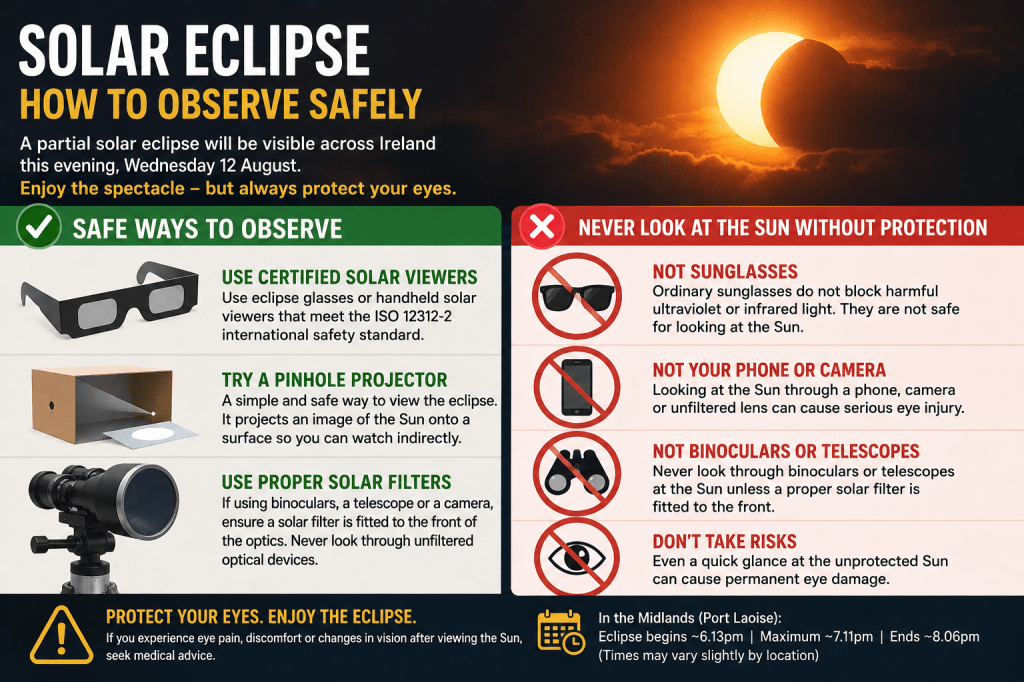
Anyone hoping to watch this evening’s eclipse should remember that it is never safe to look directly at the Sun without appropriate solar viewing protection.
Ordinary sunglasses, no matter how dark, are not sufficient. Proper eclipse glasses or solar viewers designed specifically for observing the Sun should be used. Another safe option is indirect viewing, such as a simple pinhole projector, which allows an image of the Sun to be projected onto another surface.
Cameras, binoculars and telescopes also require suitable solar filters. Looking at the Sun through an unfiltered optical device can cause serious eye injury.
An unusual Irish evening
Solar eclipses occur when the Moon passes directly between the Earth and Sun, casting its shadow across part of the Earth’s surface. Although partial eclipses are not exceptionally rare globally, an eclipse of this depth is an unusual sight from Ireland.
The spectacle should become increasingly noticeable as the Moon moves across the Sun during the early evening. At maximum eclipse shortly after 7.10pm, daylight may appear noticeably subdued before gradually returning as the Moon moves away.
As ever with astronomical events in Ireland, there is one additional participant whose cooperation cannot be guaranteed: the weather.
But if the clouds oblige, this evening offers a rare opportunity simply to look up — safely — and watch the movements of the Earth, Moon and Sun made visible in the Irish sky.

