

From old photographs and the newly released 1926 Census to Georgian houses, archaeology, oral history and the River Barrow, National Heritage Week offers plenty to explore across Counties Kildare, Laois and Carlow.
National Heritage Week begins today, Saturday 15 August, and continues until Sunday 23 August 2026. Across the country, local groups, libraries, museums, historians and heritage organisations are opening doors, sharing collections and inviting people to look again at the places around them.
Here in Mainistir Eimhín (Monasterevin), the programme is particularly local. It reaches from the changing face of the town and the long history of Moore Abbey to family history and the natural heritage of the River Barrow.

There is also much to explore within a short journey: the Georgian rooms of Stradbally Hall, the histories preserved in Cúil an tSúdaire, archaeology in Ceatharlach and an unusually varied programme at Emo Court.
This is not an exhaustive listing, but a selection of events in Mainistir Eimhín and across the neighbouring counties.
Mainistir Eimhín in pictures
Heritage Week begins locally at Mainistir Eimhín Library with a photographic journey through more than a century of the town’s history.
Pictorial History of Monasterevin from the 1890s to the 2000s brings together photographs and images of local industries, shops, businesses, market days, festivals and familiar characters.
The exhibition recalls Cassidy’s Distillery, Tyna Knitwear, Weavers Row, the Civil Defence Pipe Band, the old Bell Harbour and the Monasterevin Canal Festival. For some visitors it will be an opportunity to recognise people and places; for others, an introduction to parts of the town that have disappeared or changed beyond recognition.
The exhibition is open at Mainistir Eimhín Library, Watermill Place:
- Saturday 15 August, 10am–4pm
- Tuesday 18 August, 10am–5pm
- Wednesday 19 August, 10am–1pm
- Thursday 20 August, 1.30pm–5pm
- Friday 21 August, 10am–5pm
- Saturday 22 August, 10am–4pm
Admission is free.
Finding our families in the 1926 Census
The recent release of the 1926 Census has opened an extraordinary new window onto Ireland in the first years after independence.
At Your Ancestors and the 1926 Irish Census, professional genealogist Dr Des Murtagh will explain what the census can reveal about individuals, families and local communities.
The returns record names, ages, family relationships and occupations. In some cases they also identify employers, allowing us to see not only who lived in a household but something of how people worked and how a town functioned.
The talk takes place at Mainistir Eimhín Library on Thursday 20 August from 6.30pm to 7.30pm.
The event is free, but space is limited. Places may be booked by emailing monasterevinlib@kildarecoco.ie, telephoning 045 529239, or calling into the library.
Fifteen centuries at Moore Abbey
Local historian Barry Walsh will present Moore Abbey Demesne: A History of 1,500 Years, tracing the communities and people associated with the estate from Gaelic Ireland through the Georgian and Edwardian periods to the present day.
Organised by Monasterevin Tidy Towns with the permission of the Muiríosa Foundation, the talk is being presented on three evenings:
- Wednesday 19 August
- Wednesday 26 August
- Wednesday 2 September
Each talk begins at 7.30pm.
Although the series extends beyond Heritage Week itself, the first event forms part of the local programme. Admission is free, but numbers are limited and tickets are required. Booking information is available through Monasterevin Tidy Towns.
Sensing the River Barrow
Heritage is not confined to old buildings, records and objects. On the final day of Heritage Week, Blueway Art Studio will invite participants to experience the River Barrow through sound, sight, touch and reflection.
Sensory Mapping the River Barrow is a hands-on workshop exploring the changing character of the river, what it provides for wildlife and the parts of its heritage that may be at risk.
The workshop begins beside Big Bad Barry in Riverside Park on Sunday 23 August from 2pm to 4pm.
It is free, suitable for families and described by the organisers as autism-friendly. Advance booking is available through the event listing.
Nearby in County Kildare
Baile Átha Í (Athy) offers several opportunities to encounter its history during the week.
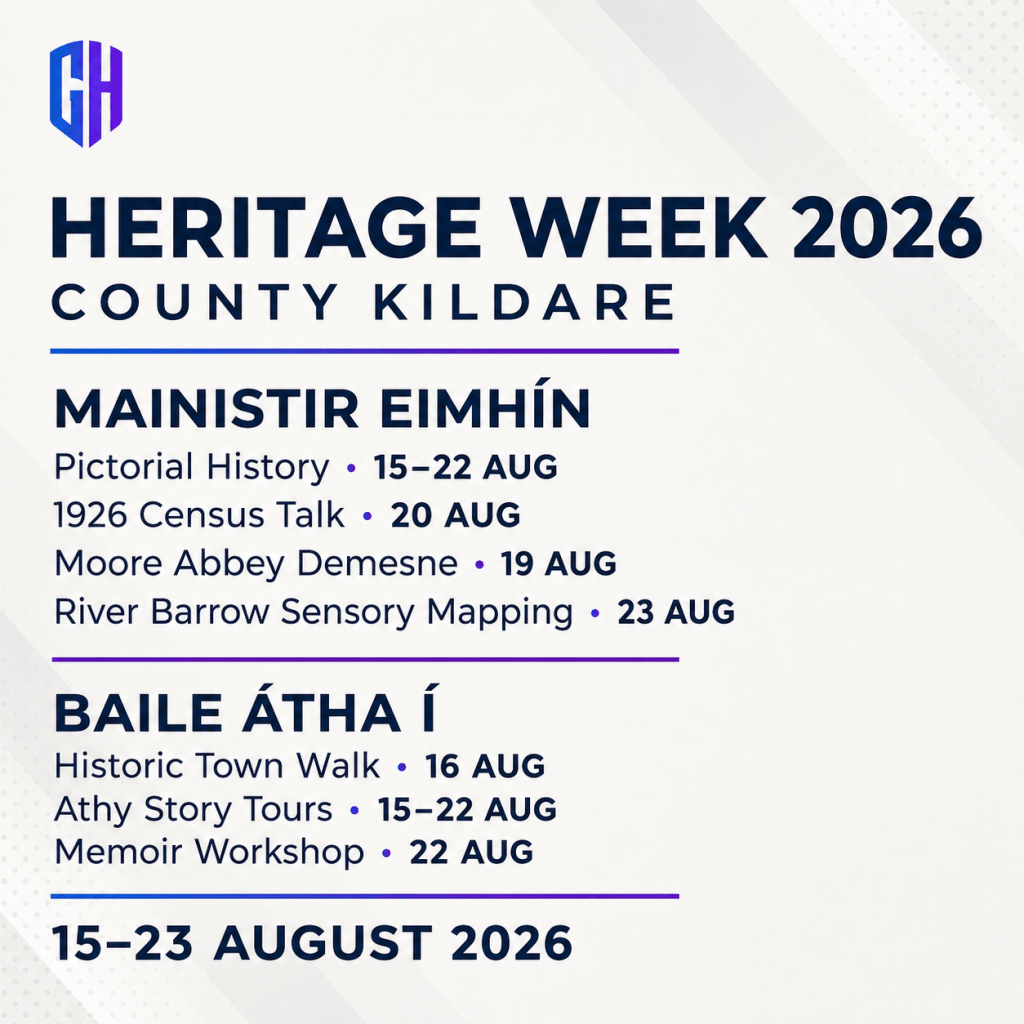
A Walking Tour of Historic Athy leaves from outside O’Brien’s Pub in Emily Square on Sunday 16 August from 3pm to 4.30pm. Led by Athy Historical Society, the walk includes the White Castle, Crom-a-Boo Bridge, St John’s Graveyard and the former Dominican church that now houses Baile Átha Í Library.
The Shackleton Experience is also offering a free Guided Tour of the Athy Story at 11.15am on 15, 18, 19, 20, 21 and 22 August. The tour follows the town’s story from its medieval origins through the 1798 Rebellion and beyond.
For those interested in recording their own history, writer Megan Wynne will lead In Her Words, a memoir-writing workshop at Baile Átha Í Library on Saturday 22 August from 2.30pm to 3.30pm. The workshop marks the centenary of Quaker author and diarist Mary Leadbeater.
Further north, events include a bat walk at the Bog of Allen Nature Centre, a community mosaic inspired by St Brigid’s Cathedral and the White Abbey in Cill Dara (Kildare town), and the opening of the Castletown Gate Houses in Celbridge.
Across the border into Laois
Cúil an tSúdaire (Portarlington) Library hosts its own Introduction to the 1926 Census on Wednesday 19 August from 2.30pm to 3.30pm. Sinéad Holland of Laois Local Studies will examine what the census tells us about Laois society after the upheavals of war, revolution, partition and independence.
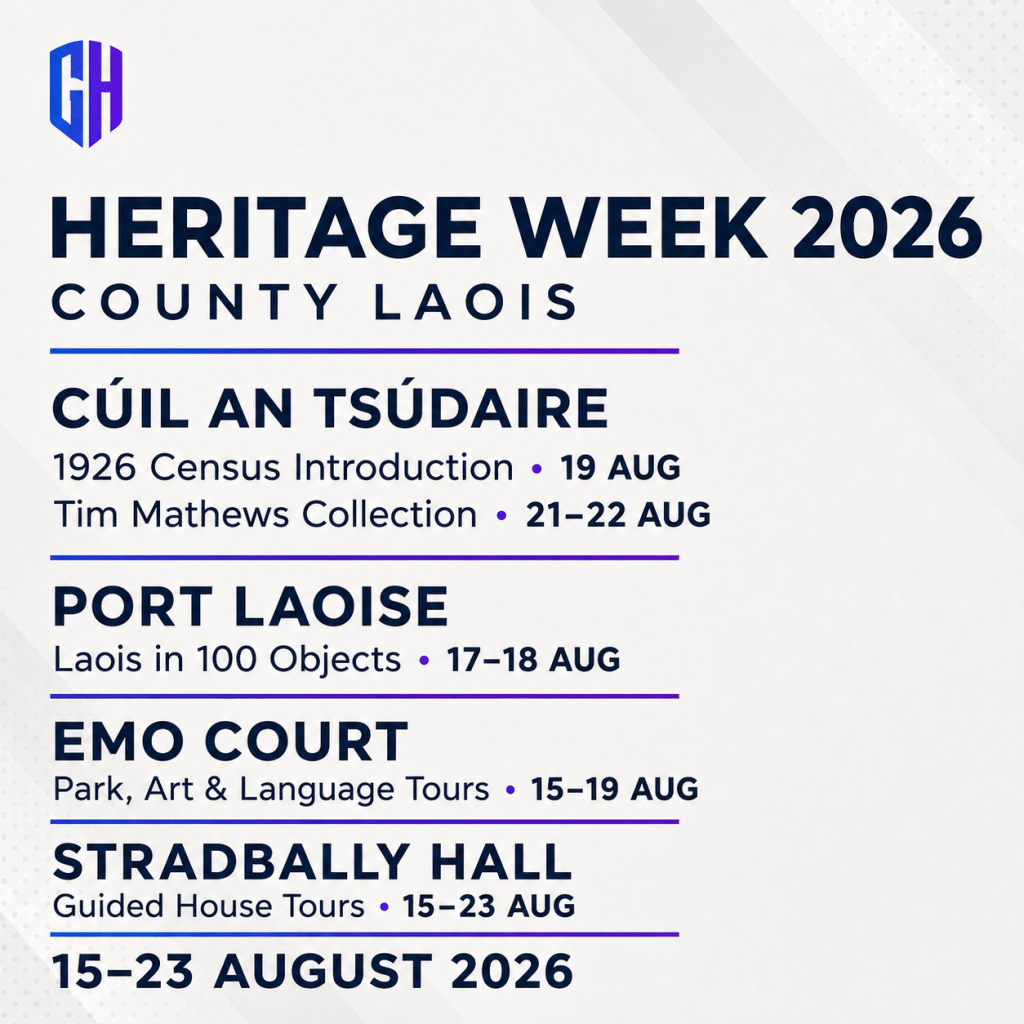
On Friday 21 and Saturday 22 August, the newly refurbished Huguenot Market House in Cúil an tSúdaire will host an exhibition from the Tim Mathews family collection. Four generations of the family preserved photographs, films, maps, papers, motoring material and family heirlooms.
The collection includes images connected with early motoring, the Gordon Bennett race and the beginnings of the Stradbally steam museum. The free, walk-in exhibition is open from 12 noon until 8pm on both days.
At Port Laoise Library, A History of Laois in 100 Objects offers a preview of a larger project being developed by Laois Heritage Office and historian Turtle Bunbury. Twelve of the proposed 100 objects will be presented on Monday 17 and Tuesday 18 August from 10am to 5pm.
Emo Court has one of the most varied programmes in the area. Events include a historical park walk, guided tours in Ukrainian and Russian, a tour of the art collection and an Irish-language tour of the house. Dates and booking arrangements vary and should be checked through the Heritage Week website.
Nearby, Stradbally Hall is offering guided tours every day from 15 to 23 August. The house has been associated with the Cosby family since 1620. Its present Georgian form dates largely from 1772, with later work by architect Charles Lanyon.
Tours begin on the hour from 2pm, with the final tour at 5pm. Admission is €10 for adults and €5 for children.
History, archaeology and memory in Ceatharlach

One of Ireland’s most remarkable prehistoric monuments will be the subject of a short public talk on the opening day of Heritage Week.
The Talk at Brownshill Dolmen, outside Ceatharlach (Carlow), takes place on Saturday 15 August from 12 noon to 12.30pm. The enormous portal tomb predates Newgrange and Stonehenge, while its capstone — weighing more than 100 tonnes — is considered the largest of its kind in Europe.
On Monday 17 August, Ceatharlach County Library hosts The Value of Oral History in County Carlow from 3pm to 3.45pm. The session will offer advice to individuals and community groups interested in recording people’s memories, while introducing existing oral-history work in Ceatharlach town.
That evening, the Seven Oaks Hotel hosts The History of the P&T in County Carlow from 8pm to 10pm, with photographs, equipment and stories tracing the changing postal and telecommunications services of the county.
For younger visitors, The Big Dig comes to Ceatharlach County Museum on Thursday 20 August from 11am to 5pm. Children aged six to twelve can work in a replica Viking house and learn how archaeologists excavate and interpret objects. The 45-minute workshops are free, but advance booking is recommended because places are limited.
An Tulach (Tullow) offers a different way of encountering local history throughout the week. Tullow Heritage Photo Orienteering invites participants to locate twelve heritage sites using photographs, clues and a map available from An Tulach Library. It is suitable for all ages and can be completed at any time during library and daylight hours.
Heritage in ordinary places
The strength of Heritage Week is not simply that important buildings open or specialists give talks. It is that familiar places are given another layer of meaning.
A riverbank becomes a record of changing relationships between people and nature. A box of family photographs becomes evidence of an industry, a vanished streetscape or an entire way of life. A census return restores names and occupations to houses we may pass every day.
In Mainistir Eimhín and across this neighbouring part of Kildare, Laois and Carlow, much of our heritage is shared across present county boundaries. Rivers, canals, railways, estates, industries, religious communities and families have never fitted neatly inside administrative lines.
Heritage Week gives us an opportunity not merely to admire the past, but to notice how it remains present: in buildings, landscapes, memories, family stories and the names by which we know a place.
Event details can change and some activities require advance booking. Readers should check the individual listing before travelling.
Sources
All event information was checked against the official National Heritage Week listings on 15 August 2026.
Mainistir Eimhín
- Pictorial History of Monasterevin from the 1890s to the 2000s
- Your Ancestors and the 1926 Irish Census
- Moore Abbey Demesne: A History of 1,500 Years
- Sensory Mapping the River Barrow
County Kildare
- Walking Tour of Historic Athy
- Guided Tour of the Athy Story
- In Her Words: Memoir Writing Workshop
- Complete County Kildare programme
County Laois
- Introduction to the 1926 Census
- Tim Mathews Family Collection
- A History of Laois in 100 Objects
- Guided Tours of Stradbally Hall
- National Heritage Week event listings

