
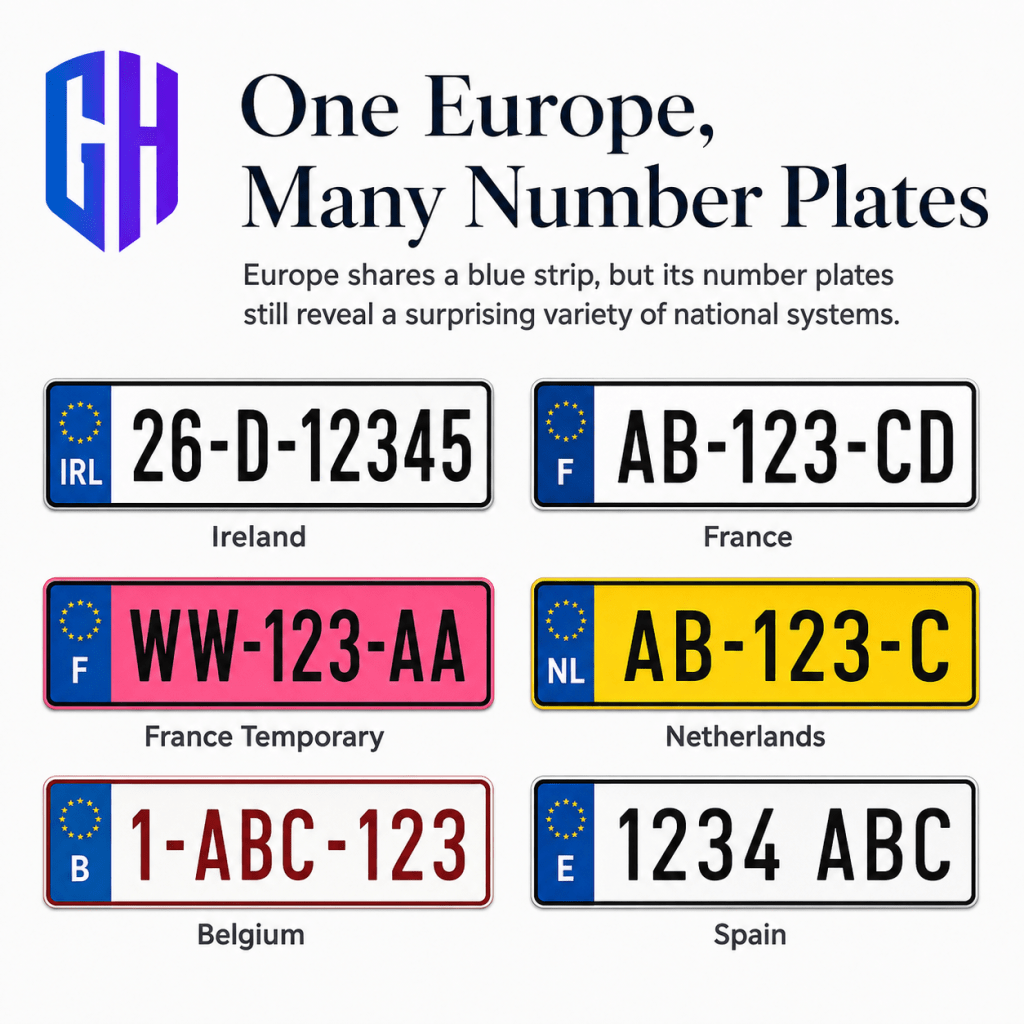
Europe shares a blue strip, but its number plates still reveal a surprising variety of national systems.
A bright pink French number plate seen in Port Laoise recently was striking enough to prompt a question: what exactly was it?
The answer was relatively simple. France introduced pink plates for certain temporary registrations from the beginning of 2026. Temporary WW registrations and professional W garage registrations now use black characters on a pink background, making their temporary status much easier to recognise. (Service Public)
But look around any busy road, motorway service area or ferry port in Ireland and that French plate is only one example of the extraordinary variety of registration plates which can arrive here from elsewhere in the European Union.
There is something distinctly European about them all — yet there is remarkably little uniformity.
The familiar blue strip
Probably the closest thing Europe has to a common number plate is the blue strip at the left.
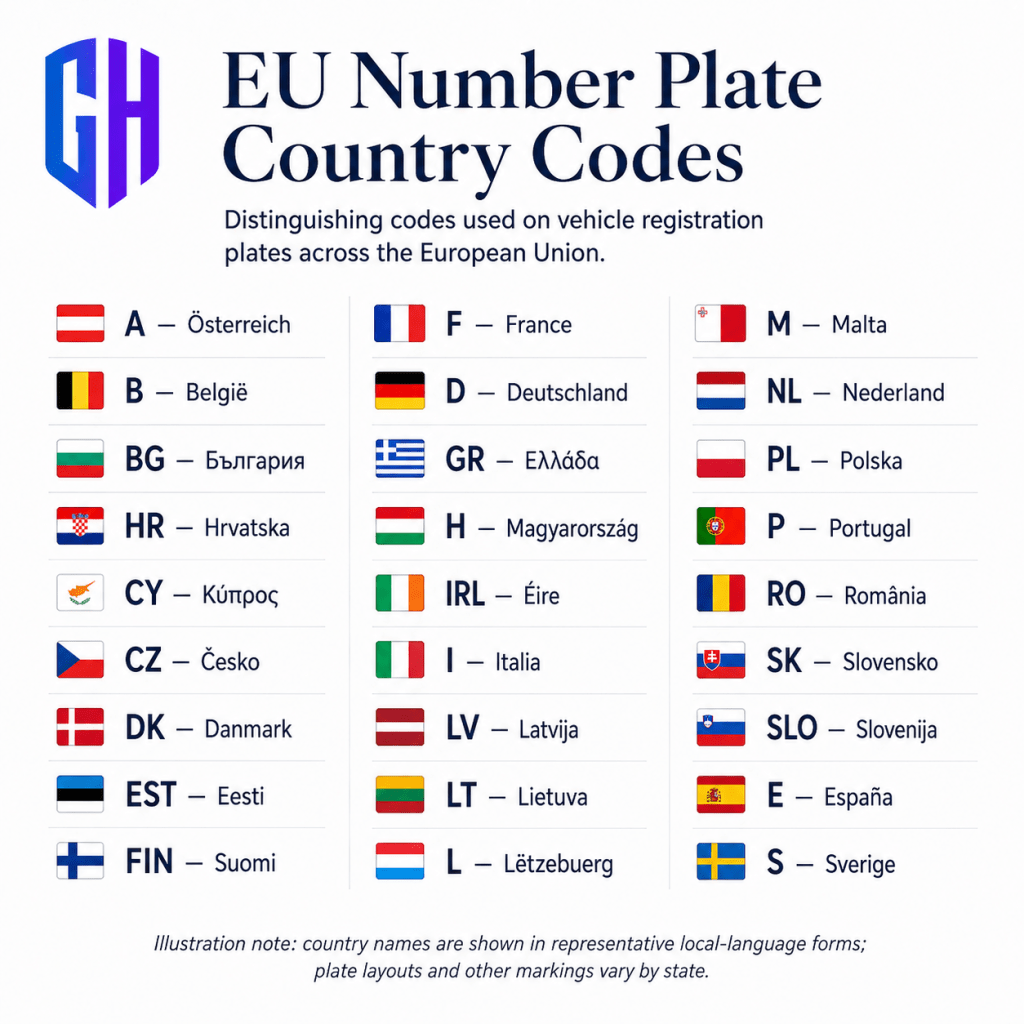
The standard European model places the twelve yellow stars of the European flag above the distinguishing letters of the country in which the vehicle is registered: IRL for Ireland, F for France, D for Germany, E for Spain, NL for the Netherlands and so on.
European legislation recognises this as the distinguishing sign of the state of registration. (EUR-Lex)
Beyond that little blue strip, however, countries largely go their own ways.
Ireland: a registration you can read
Ireland has one of the more immediately informative systems.
An Irish registration tells us the year—and, on newer vehicles, which half of the year—in which the vehicle was first registered, followed by a county or city identifier and a serial number.
That makes an Irish plate something more than a simple identity number. Anyone familiar with the system can immediately extract information from it.
Irish plates are predominantly white with black characters. Since July 2025, eligible zero-emission vehicles can also carry a green vertical flash on the right-hand side, mirroring the blue European strip on the left. (Gov.ie)
France: deliberately anonymous
France takes a very different approach.
The modern French registration generally follows a two-letter, three-number, two-letter arrangement. Unlike older French plates, it does not encode the vehicle’s département into the registration number itself.
A regional identifier may appear separately on the plate, but the registration belongs to the vehicle rather than being rewritten simply because its owner moves across France.
And, as of 2026, France has added something dramatically more visible: pink temporary plates. (Service Public)
They are difficult to miss.
The Netherlands: yellow means Dutch
Then there are the Dutch.
Few European registrations are as instantly recognisable from a distance. Ordinary Dutch plates use black characters on a bright yellow reflective background, with the familiar blue European band carrying NL at the left.
The Dutch vehicle authority, RDW, specifies the blue EU symbol and NL identifier as part of the standard yellow plate. (RDW)
You may not have read a single letter of the registration, but when a yellow plate appears ahead on an Irish road there is a fair chance that you already know where it has come from.
Belgium does things differently again
Belgian registrations are another distinctive sight.
Belgium has its own registration conventions and even retains a system in which the official rear plate is issued by the authorities, while the front plate is effectively its matching copy.
There are also special registrations. Belgian trade and test plates, for example, use moss-green characters on a white reflective background, with different initial letters identifying test, dealer and professional registrations. (Mobility)
So even within a single country, colour can tell part of the story.
Spain: simple and national
Spain’s ordinary registration is much easier to decipher structurally: four numbers followed by three letters, in black on white, with the blue European strip carrying the letter E.
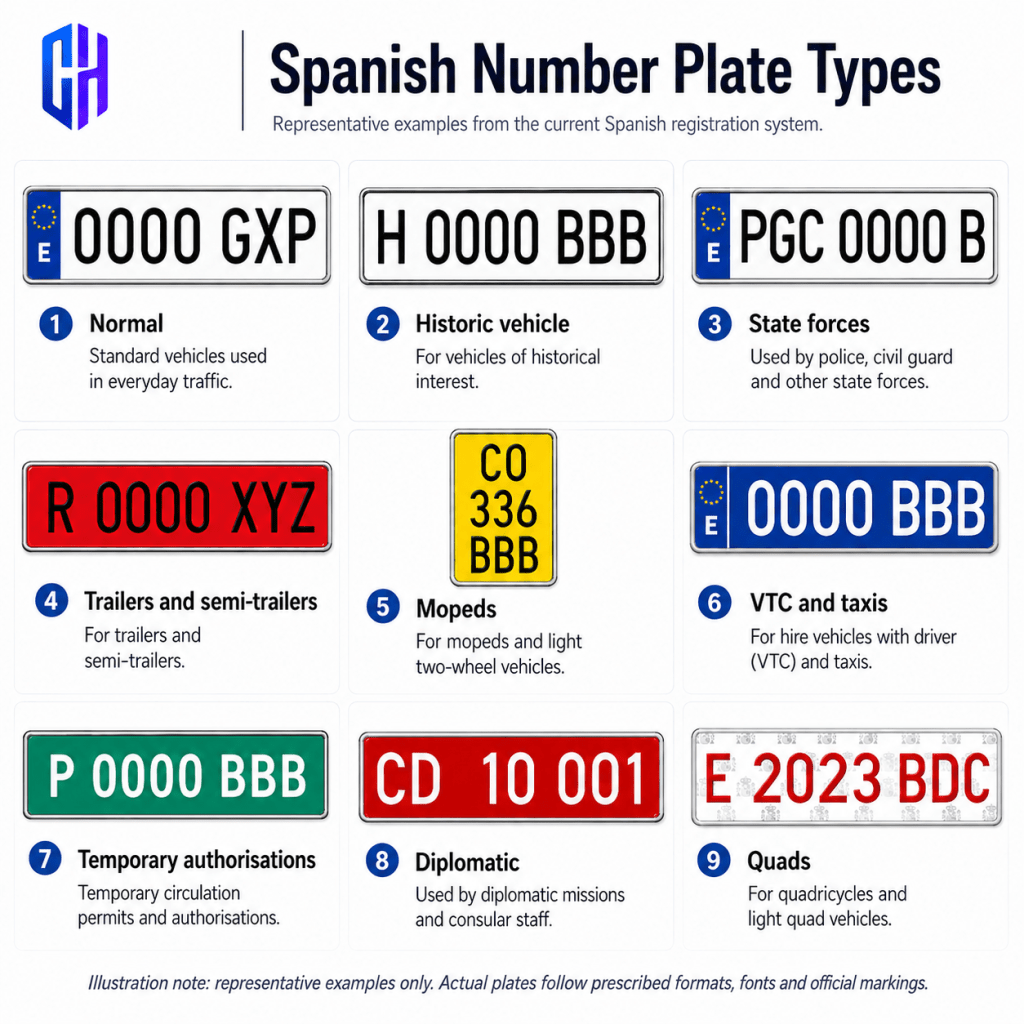
The present Spanish system deliberately does not use the registration to identify a province. (DGT)
Again, that contrasts sharply with Ireland, where geography remains visibly built into the registration.
A European system—almost
And this is perhaps the curious part.
Drive from Ireland through France, Belgium, the Netherlands, Germany and onwards into central Europe and you remain within one European Union.
The same European flag appears on plate after plate.
Yet the plates themselves can be white, yellow or—temporarily in France—vivid pink. Some registrations tell you where a vehicle came from. Others deliberately do not. Some remain with a vehicle; other national systems have historically associated numbers more closely with owners or places.
There is common recognition, but no common registration scheme.
That raises an interesting question.
Should there be one?
A genuinely uniform EU registration system could retain a national identifier while using the same basic structure, typography and rules in every member state.
It would potentially make plates easier for motorists, police, toll operators, parking systems and cameras to recognise across borders. A registration could still identify its member state without every country having to maintain a visibly different system.
There is an obvious model already sitting on millions of vehicles: the blue European strip.
One could imagine a system in which the first element identified the member state, while the remaining letters and numbers were issued according to an agreed European format.
But there is an equally good argument for leaving things alone.
Registration plates have become small pieces of national visual culture. The yellow Dutch plate, the red characters associated with Belgium, the Irish county letters and the differing arrangements of letters and numbers all tell us something about where a vehicle belongs.
Uniformity might make administration neater while making European roads a little less interesting.
And perhaps the present arrangement is rather European in itself: a common framework, a shared symbol and mutual recognition—with each country still doing things in its own particular way.
That bright pink French plate in Port Laoise therefore tells a bigger story than might first appear.
It identifies a temporary French registration.
But it also illustrates something about Europe: twenty-seven member states, interconnected roads and borders, a common blue strip—and twenty-seven different ideas about what should go beside it.