

One comment from the recent discussion about the PSNI and Pride has stayed with me.
Deputy Chief Constable Bobby Singleton described the decision to end the PSNI’s participation in Pride parades as the “hardest” and “most difficult” decision of his 25 years in policing.
Perspective and Context
I do not doubt that it was a difficult decision. Police leaders have to balance operational impartiality, public confidence, legal advice, and the welfare of their officers and staff. Those are not easy responsibilities.
But I struggle with the language.
Twenty-five years of policing takes us back to around 2001, after the Belfast Agreement. The experience of policing Northern Ireland since then has been very different from policing during the Troubles. Yet it has still involved terrorism, murders, bombings, shootings, riots, organised crime, domestic abuse, sexual violence, child exploitation, and countless moments requiring immense professional judgement and compassion.
Against that background, describing a decision about participation in Pride parades as the hardest decision of an entire policing career feels like a remarkable statement.
Human Rights v Political Privilege
The debate has also revealed something deeper.
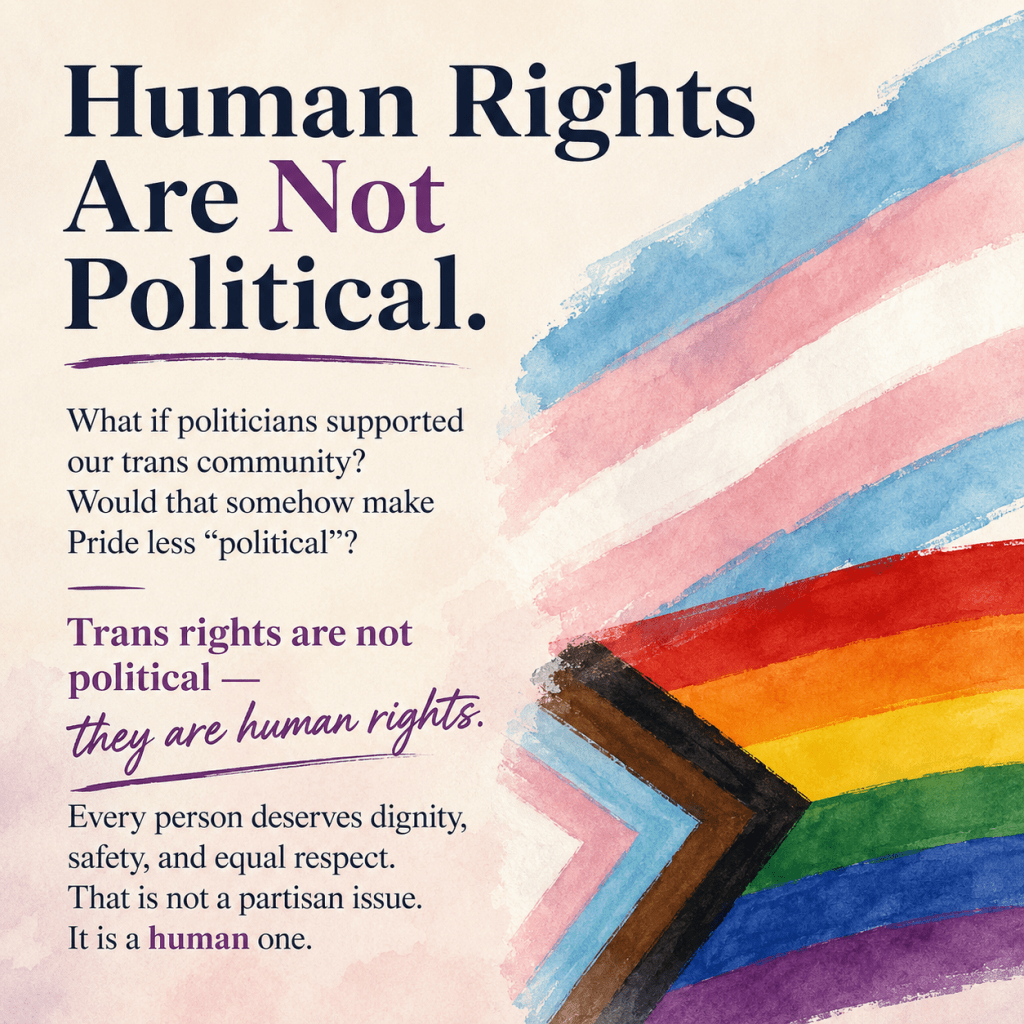
Some have argued that Pride is “political” because it supports transgender people and campaigns for legal and social change. Yet that raises an important question: if politicians supported transgender people instead of opposing them, would their rights suddenly cease to be political?
The right of transgender people to live free from violence, discrimination, and hatred is not a political privilege granted by whichever party happens to be in power. It is a human right. Their dignity does not depend on the outcome of an election or the views of a political party.
Disagreement Over Policy v Disagreement Over Humanity
Of course, there are legitimate debates about legislation, healthcare, education, and public policy. In a democracy those debates are inevitable. But we should be careful not to confuse disagreement over policy with disagreement over a person’s humanity.
Pride has always contained an element of advocacy because LGBTQ+ people have often had to advocate simply to be treated equally before the law and within society. That history should not be forgotten. Supporting the equal dignity of LGBTQ+ people is not the same as endorsing every campaign or policy associated with Pride.
The Risk to Justice and Compassion
For me, the more troubling question is not whether Pride contains political advocacy. It is whether we have reached a point where affirming the equal worth of transgender people is itself treated as a political act.
Human dignity should never become a partisan issue. A society that cannot distinguish between political disagreement and the equal worth of every human being risks losing sight of both justice and compassion.

