Eóin Tennyson’s Private Member’s Bill would create three criminal offences relating to attempts to change or suppress sexual orientation or gender identity. This article will follow its progress, scrutiny and the arguments surrounding it.
This is a developing article. It will be updated as the Bill progresses through the Northern Ireland Assembly. The newest developments appear first.
Tracking developments from 30 June 2026.
The Northern Ireland Assembly is considering legislation intended to criminalise practices aimed at changing or suppressing a person’s sexual orientation or gender identity.
Conversion-practices Bill passes Second Stage
29 September 2026
Confirmed: On 28 September, MLAs approved the Conversion Practices (Criminalisation) Bill at Second Stage by 46 votes to 29. The Assembly’s motion record confirms that the motion was carried.
Why it matters: The Bill has cleared its first substantive vote and can proceed to detailed examination by the Committee for Communities. It is not yet law; the Committee may recommend changes before later Assembly stages.
What MLAs said on 28 September
The debate returned to how the Bill would prohibit harmful conversion practices while making the boundaries of criminal offences clear. DUP MLAs Diane Forsythe and Paul Givan pressed for a definition of “gender identity”. Communities Minister Gordon Lyons argued that the wording on counselling, coaching and instruction could reach parental guidance or pastoral care. TUV MLA Timothy Gaston raised similar concerns about religious freedom and consent. These were arguments about the proposed law, not findings that ordinary conversations would be criminalised.
People Before Profit MLA Gerry Carroll supported the Bill, saying existing law does not adequately address psychological and coercive practices. Independent MLA Claire Sugden also voted for Second Stage, but said committee scrutiny must examine parenting, psychological harm and existing legal protections. She warned that her support at later stages depends on satisfactory changes.
Bill sponsor Eóin Tennyson replied that an offence would require proof of conduct, intent and harm. He said he was open to adding a statutory definition of “gender identity” and reviewing the harm threshold, while opposing blanket exemptions for homes or churches.
Analysis: The 46–29 vote allows detailed scrutiny to begin; it does not settle these drafting disputes. The Committee for Communities can examine the evidence and propose amendments before the Bill returns to the Assembly. Read the 28 September Assembly Hansard.
Second Stage scheduled to resume on 28 September
24 September 2026
Confirmed: The Northern Ireland Assembly’s Bill page now lists 28 September 2026 for Second Stage. Debate resumed on 22 September but ended without a vote. The Bill remains at Second Stage.
Why it matters: MLAs now have a date to continue considering whether the Bill should proceed. Formal Committee Stage still depends on a Second Stage decision; the Committee’s Bill page says referral will follow only if the Bill passes.
Second Stage debate resumes without a vote
23 September 2026
Confirmed: The Assembly resumed the Conversion Practices (Criminalisation) Bill’s Second Stage debate on 22 September, but did not reach a decision. Its official AIMS record lists the outcome as “No vote”. The Bill remains at Second Stage and has not been referred to the Committee for Communities.
Why it matters: Committee scrutiny cannot formally begin until MLAs approve the Bill’s general principles. The further delay adds pressure to the Committee timetable it discussed on 17 September; it does not indicate that the Bill has passed or failed.
Analysis: A further sitting will be needed for a Second Stage decision. Read the official 22 September Hansard · Follow the Assembly Bill page.
Committee scrutiny timetable cut by Second Stage delay
18 September 2026
The Communities Committee confirmed on 17 September that it could not agree its planned Committee Stage arrangements because the Bill’s Second Stage debate had not concluded.
Chair Colm Gildernew said that, if the Bill passes on 22 September, the Committee’s original scrutiny timetable will need to be recalculated and has already been shortened by two weeks. It may need to be compressed further.
Why it matters: the Bill has not yet entered Committee Stage. The timetable for detailed examination has already shortened and will need recalculating if MLAs approve its general principles. That could place greater pressure on scrutiny before the mandate ends.
Watch the Communities Committee meeting · View the official AIMS meeting record · View the Second Stage motion record
Second Stage debate exposes divide over scope and safeguards
16 September 2026
The first part of the Assembly’s official record of the Second Stage debate has now been published.
Bill sponsor Eóin Tennyson argued that existing offences do not adequately cover organised talking therapies, coercive conduct outside relationships already covered by domestic-abuse law, or taking someone outside Northern Ireland for conversion practices. He said the proposed offences require an intention to change or suppress a person’s sexual orientation or gender identity and, depending on the offence, actual harm or coercive conduct. He maintained that ordinary expressions of belief and legitimate parental, pastoral and clinical conversations would not meet those tests, while indicating that he was open to amendments providing further clarity.
Alliance, Sinn Féin and SDLP speakers heard so far supported the Bill’s principles. Mark H Durkan, Deirdre Hargey, Nuala McAllister, Sinéad Ennis and Paul Boggs emphasised the harm attributed to conversion practices and distinguished private belief from conduct intended to change or suppress another person’s identity. Sinn Féin stated explicitly that it supports legislation banning conversion practices while allowing for detailed scrutiny.
DUP speakers Diane Dodds, Peter Martin and Harry Harvey, together with UUP leader Jon Burrows, opposed the Bill as drafted. Their principal concerns were the definitions of conversion therapy, coercion, psychological harm and gender identity; the absence of a general parental, pastoral or religious exemption; the treatment of consent; and the possibility that people could face investigation before relying on the Bill’s reasonableness defence. They argued that the legislation could chill lawful conversations and that some of the conduct cited by supporters is already criminal.
Analysis: the division is not principally over whether violent, degrading or coercive abuse is wrong. The argument is over whether the Bill identifies gaps in existing law with sufficient precision and whether its thresholds and defences adequately protect ordinary family, religious, counselling and clinical interactions. Those questions are likely to dominate the resumed debate and, if the Bill passes Second Stage, Committee scrutiny.
The Hansard publication available at the time of this update is incomplete: it ends during Paul Frew’s contribution and says that the remainder will be published on 16 September. This summary therefore covers only the contributions officially published so far. Colm Gildernew’s contribution as Chair of the Committee for Communities was procedural and did not state a Committee position.
Read the official Hansard · View the AIMS motion record · Watch the official Assembly broadcast
Second Stage debate remains undecided
15 September 2026
The Assembly began debating the Conversion Practices (Criminalisation) Bill at Second Stage on 15 September, but the sitting was adjourned before the debate concluded. The debate is due to resume on Tuesday 22 September 2026.
The Bill therefore remains at Second Stage: it has neither passed nor been defeated, and no referral to the Committee for Communities has yet taken place. MLAs must complete the debate and decide whether to approve its general principles.
Read the AIMS motion record · Watch the official Assembly broadcast
Conversion-practices Bill set for first Assembly debate
5 September 2026
The Conversion Practices (Criminalisation) Bill is now scheduled for its Second Stage on 15 September 2026. Sponsor Eóin Tennyson MLA tabled the motion on 1 September, according to the Assembly’s official AIMS record.
This is the Bill’s first substantive Assembly test: MLAs will debate its principles and decide whether it should proceed. If approved, it can advance to detailed committee scrutiny. The Assembly’s main Bill page still says that Second Stage is “to be scheduled,” so the AIMS entry appears to contain the newer timetable information.
The Conversion Practices (Criminalisation) Bill, introduced by Alliance Party deputy leader Eóin Tennyson MLA, completed First Stage on 30 June 2026. Following debates on 15, 22 and 28 September, the Assembly approved its general principles at Second Stage on 28 September. It now moves to detailed Committee scrutiny.
The Committee for Communities has opened a call for evidence. Members of the public and interested organisations can submit their views until 1 October 2026.
This article will be updated as the Bill progresses, recording its legislative stages, proposed amendments, votes and significant responses from supporters, opponents and affected communities.
What would the Bill do?
As introduced, the Bill would create three criminal offences:
- providing conversion therapy;
- engaging in coercive conversion behaviour; and
- causing or helping someone to leave Northern Ireland to undergo conversion practices.
For the first two offences, the prosecution would have to establish an intention to change or suppress the person’s sexual orientation or gender identity and that physical or psychological harm resulted.
The Bill defines conversion therapy as counselling, talking therapy, coaching, instruction or purported treatment. Coercive behaviour can include violence, threats, controlling someone’s everyday activities, restricting their freedom or repeatedly making them feel frightened, humiliated, degraded, punished or intimidated.
Psychological harm would include fear, alarm or distress.
Consent would not provide a defence. However, each of the proposed offences includes a defence that the accused person’s actions were reasonable in the particular circumstances.
The maximum penalty would be 12 months’ imprisonment or a fine following summary conviction, or two years’ imprisonment or a fine following conviction on indictment.
Healthcare, belief and pastoral conversations
The legislation expressly excludes treatment provided by certain regulated healthcare professionals when it complies with the standards and ethical codes governing their work.
It also states that merely expressing a belief or opinion would not constitute an intention to change or suppress someone’s identity, provided the person is not being directed towards a particular sexual orientation or gender identity.
That distinction is likely to become one of the principal subjects of scrutiny.
The Bill’s supporters argue that expressions of faith and genuinely non-directive pastoral conversations remain protected. Some religious and conservative organisations, however, contend that the absence of a specific exemption for pastoral care, parents and informal community support could create uncertainty.
The precise boundary between expressing a belief, offering support and intentionally directing another person towards suppressing part of their identity will therefore be central to the Assembly’s consideration.
Why has the Bill been introduced?
The Assembly passed non-binding motions supporting action against conversion practices in 2021 and 2024.
Research published in May 2024 by Professor Fidelma Ashe and Dr Danielle Mackle found evidence of conversion practices being offered or undertaken in Northern Ireland during the preceding ten years. Participants described experiences involving young adults and children in spiritual, healthcare and educational settings.
The Department for Communities is not expected to introduce its own legislation during the present Assembly mandate. Tennyson has therefore proceeded by way of a Private Member’s Bill.
Responses to the Bill
Introducing the legislation, Tennyson said its purpose was to protect LGBTQIA+ people from acts causing physical or psychological harm and intended to change or suppress who they are.

Northern Ireland Humanists welcomed its introduction, arguing that any prohibition must protect both gay and transgender people and must not contain loopholes allowing coercive practices to continue in religious settings. Coordinator Boyd Sleator described the Bill as an important step towards recognising that being LGBT+ is not something requiring a cure. Read its response.
Core Issues Trust and the International Foundation for Therapeutic and Counselling Choice have opposed aspects of the legislation. They argue that, while abusive and coercive conduct should not be defended, the Bill does not expressly recognise what they describe as lawful pastoral care outside regulated healthcare. Read their statement.
Democratic Unionist Party
On 12 September 2026, DUP leader Gavin Robinson confirmed that his party’s MLAs would “oppose the bill robustly”. He argued that its definitions were too uncertain and could interfere with parental responsibility, pastoral care and religious liberty. Robinson also cited legal advice from Aidan O’Neill KC questioning whether parts of the Bill fall within the Assembly’s legislative competence.
These are political and legal arguments advanced by the DUP, not findings made by a court or the Assembly. The intervention nevertheless establishes the position of the Assembly’s largest unionist party ahead of Second Stage.
Read Gavin Robinson’s article in the News Letter
Further responses will be added as they are published.
Bill progress
Current status
Second Stage approved on 28 September
The Assembly approved the Bill’s general principles at Second Stage on 28 September 2026. It proceeds to the Committee for Communities for detailed scrutiny.
This is approval to examine the Bill further, not enactment. The Committee may recommend amendments before later Assembly stages.
Public call for evidence
Closes: 1 October 2026
The Committee for Communities is inviting individuals and organisations to comment on the Bill’s objectives, provisions and possible consequences.
Submit evidence to the Committee
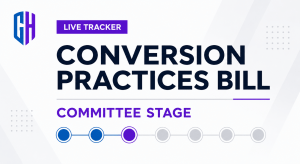
Progress tracker
28 September 2026
Second Stage approved
MLAs approved the Bill’s general principles by 46 votes to 29. It proceeds to the Committee for Communities for scrutiny and possible amendments. View the Assembly motion and vote.
24 September 2026
Second Stage rescheduled
The Assembly Bill page schedules Second Stage for 28 September, following the 22 September debate without a vote. Committee Stage remains contingent on approval.
22 September 2026
Second Stage resumes; no vote
The Assembly resumed debate but did not decide whether the Bill should proceed. The AIMS motion record reports “No vote”. Formal Committee Stage remains pending.
17 September 2026
Committee timetable must be recalculated
The Communities Committee could not agree its planned Committee Stage arrangements because Second Stage had not concluded. If the Bill passes, its scrutiny timetable will already be two weeks shorter and may need further compression. Watch the Committee meeting · View the AIMS record.
15 September 2026
Second Stage debate adjourned
The Assembly began debating the Bill’s general principles but adjourned before a decision. Debate resumed on 22 September without a vote.
1 September 2026
Second Stage scheduled
Eóin Tennyson MLA tabled the motion for the Bill’s Second Stage. The Assembly’s AIMS record lists the debate for 15 September 2026.
9 July 2026
Call for evidence opened
The Committee for Communities opened its public consultation. Responses will be accepted until 1 October 2026.
2 July 2026
Committee prepares for scrutiny
The Committee agreed to launch a call for evidence. Formal Committee Stage remains dependent upon the Bill passing Second Stage.
30 June 2026
First Stage completed
Eóin Tennyson MLA formally introduced the Conversion Practices (Criminalisation) Bill. It passed First Stage and was ordered to be printed.
5 December 2024–20 March 2025
Initial public consultation
Tennyson consulted on the original legislative proposals. A total of 1,288 responses were received.
What happens next?
The Committee for Communities will examine the Bill in detail, take evidence and consider whether to recommend amendments. Further Assembly stages would still be required before it could become law.
Official documents
- Follow the Bill’s official progress
- Read the Bill as introduced
- Read the Committee’s call for evidence
- Read the 15 September Second Stage debate in Hansard
Tracker last updated: 29 September 2026
Gyronny Herald comment
The central principle should be straightforward: nobody should be subjected to coercion, humiliation or purported treatment because somebody else believes that their sexual orientation or gender identity must be changed or suppressed.
That principle does not require the criminalisation of private belief, theological teaching or genuinely open pastoral conversation. The Bill itself attempts to preserve that distinction by requiring intent, harm and, in cases of coercive behaviour, a repeated course of conduct.
Those safeguards deserve careful legal scrutiny. So too does the breadth of “psychological harm”, which includes fear, alarm or distress. The Assembly must ensure that the legislation is sufficiently precise to be enforceable, while resisting attempts to create exemptions broad enough to permit harmful practices to continue behind the language of religion, counselling, parental concern or supposed consent.
Religious freedom protects the right to hold and express beliefs. It should not provide permission to subject another person to a deliberate programme intended to suppress who they are.
The proper question is not whether faith and LGBTQIA+ dignity can coexist. Many people already embody both. The question is where lawful belief ends and coercive conduct causing harm begins.
That boundary must be drawn carefully—but it must be drawn.

