
Farage’s vote barely changed; the missing principal parties made his apparent landslide considerably larger.
Raw vote totals show that Reform UK’s leader added only 1,014 votes as the principal parties stayed away and turnout fell sharply.
Nigel Farage has returned to Parliament with what appears, at first glance, to be an emphatic endorsement from the voters of Clacton. He won 63.3 per cent of the vote in the by-election held on 13 August 2026, comfortably defeating Count Binface, who finished second on 26.9 per cent.
Those percentages, however, compare two elections that were fundamentally different.
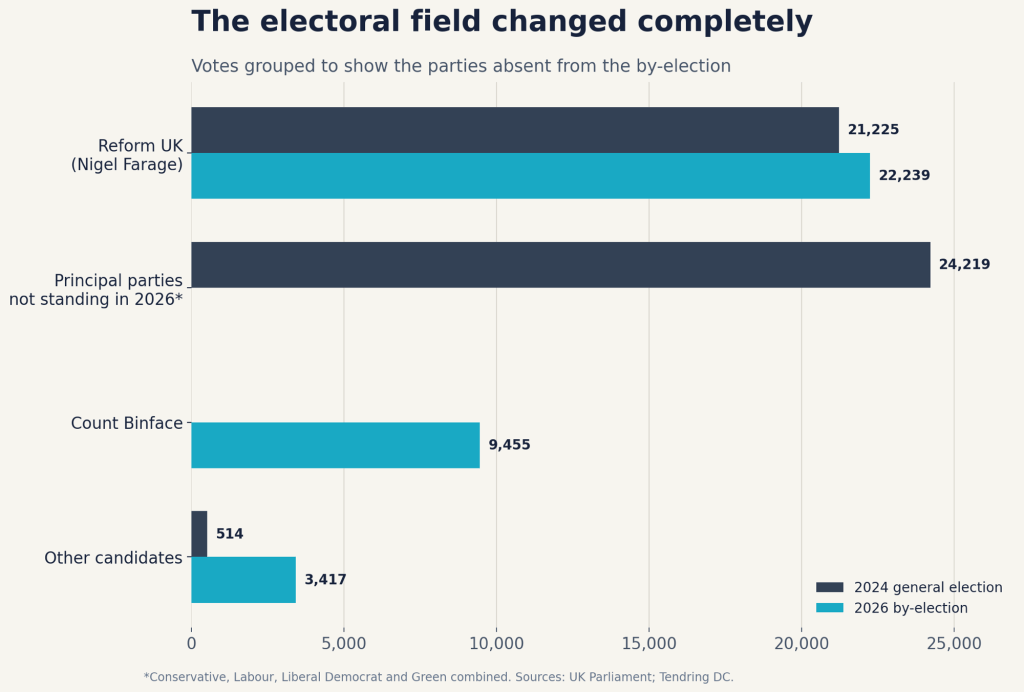
The Conservative Party, Labour Party, Liberal Democrats and Green Party did not contest the by-election. In the 2024 general election, those four parties received 24,219 votes between them. Removing all four from the ballot inevitably transformed the percentages available to the candidates who remained.

Farage’s vote rose—but only slightly
Farage received 21,225 votes at the 2024 general election. This time he received 22,239: an increase of 1,014 votes.
That is evidence of a resilient and well-mobilised local following. It is not, though, remotely equivalent to the 17.1 percentage-point rise displayed in conventional election tables.
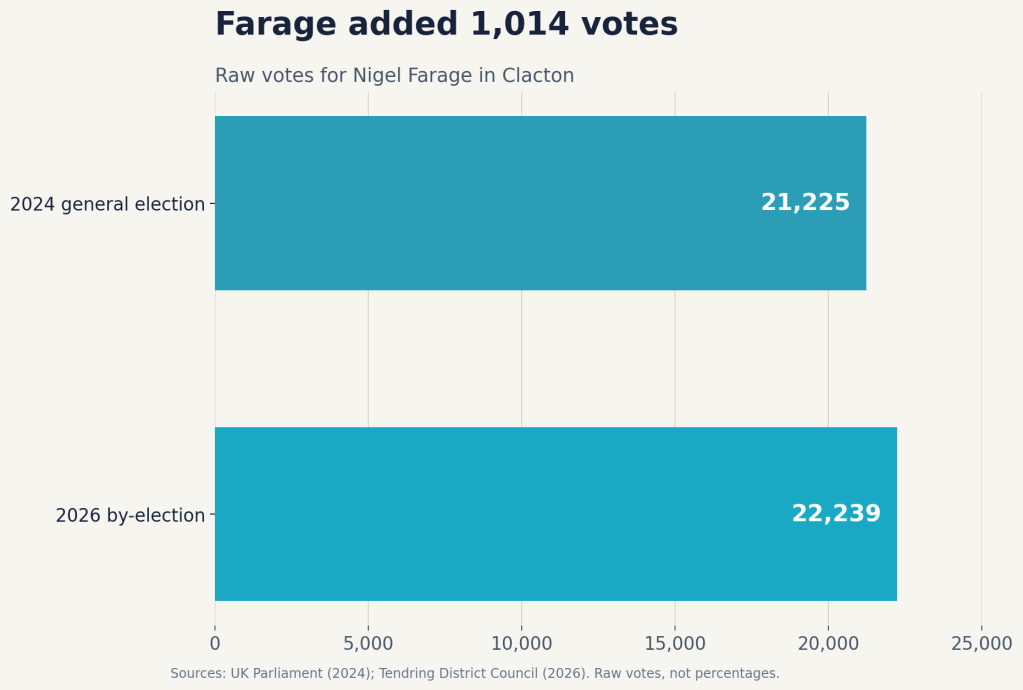
Nigel Farage’s raw vote increased from 21,225 in 2024 to 22,239 in 2026.
The electorate grew from 78,245 to 79,785. Measured against everyone registered to vote, Farage was supported by approximately 27.1 per cent of the electorate in 2024 and 27.9 per cent in 2026. On that measure, the movement was less than one percentage point.
More than ten thousand fewer votes were cast
Turnout fell from 58.7 per cent in 2024 to 44.37 per cent in the by-election. There were 45,958 valid votes in the general election, compared with 35,111 votes cast for candidates this time—a reduction of 10,847.
Yet Farage’s own total increased slightly. That suggests that Reform UK successfully retained and mobilised its established vote while many people who had previously supported one of the absent parties stayed at home or chose among the unconventional alternatives.
Count Binface received 9,455 votes—an extraordinary result for a satirical candidate, and considerably more than the 7,448 votes secured by Labour in Clacton in 2024. Those votes cannot simply be treated as support for a conventional opposition platform. They are likely to include humour, protest, tactical anti-Farage voting and genuine enthusiasm for the candidate.
A strong core vote, not a conventional landslide
Farage’s majority increased from 8,405 over the Conservative candidate in 2024 to 12,784 over Count Binface in 2026. But those majorities are not directly comparable: the identity and character of the runner-up changed completely.
The result demonstrates something politically significant. Farage’s core support in Clacton has held firm and was motivated to vote in an unusual August by-election. Reform UK can reasonably point to the fact that its candidate gained votes despite the steep decline in turnout.
What the result does not demonstrate is that nearly two-thirds of Clacton’s electorate now supports Farage or Reform UK. Farage received the votes of just under 28 per cent of registered electors. His 63.3 per cent share describes the votes cast in a contest from which the principal opposition parties had deliberately withdrawn.
The raw numbers therefore offer a more restrained verdict than the headline percentage: a modest increase for Farage, a remarkably durable core vote, and a by-election whose unusual ballot makes broader claims about public opinion difficult to sustain.
Sources: UK Parliament Clacton 2024 Election Result; Tendring District Council Clacton By-election result

